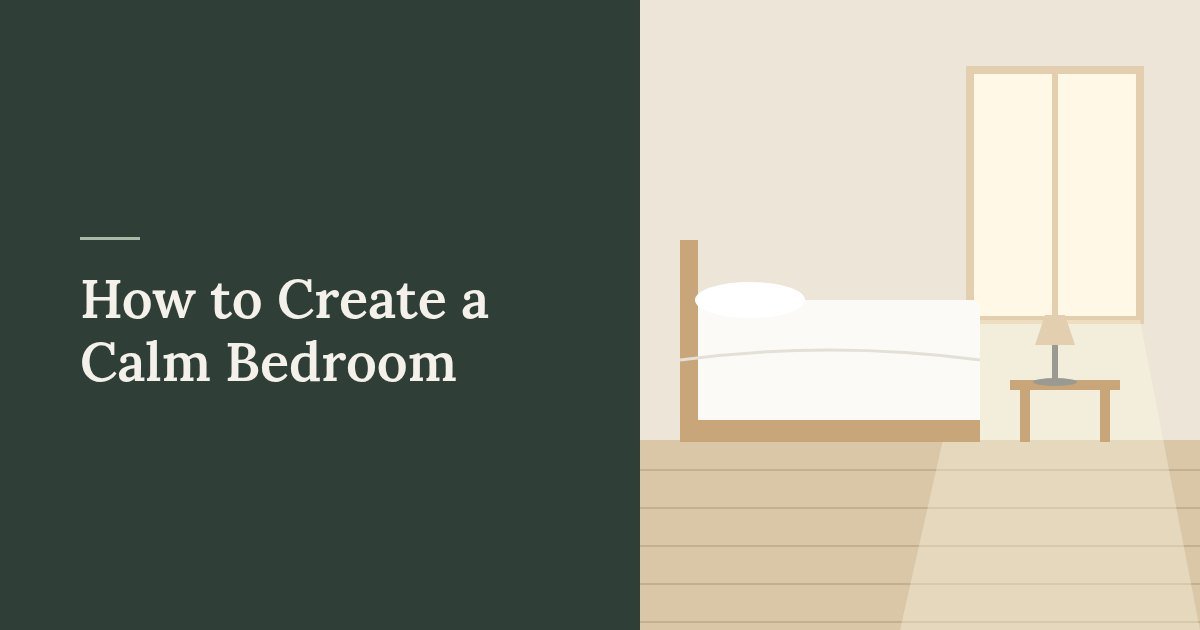
If you want to know how to create a calm bedroom, change it in a fixed order: light control first, then what leaves the room, then surfaces and storage, then bedding and texture, then sound. That order matters, because the later changes only hold once the earlier ones are done. New pillows on a room with four bags on the chair still reads as a busy room.
Everything below describes the room, not the person in it. The measures are physical: how much light gets in at 6 a.m., how many objects are visible from the doorway, how long it takes to put the room back.
To create a calm bedroom, start with light control
Light is the one thing in a bedroom you cannot style your way around. A room with thin curtains is bright at dawn whatever the bedding looks like.
Work through the openings in this order:
- Measure the window, not the old curtain. Note the width of the window plus 8 to 12 inches on each side, so the panel can overlap the frame instead of ending at it.
- Fix the gap at the top. Most light comes in over the rod, not through the fabric. A ceiling-mounted track, a cornice, or a rod set 4 to 6 inches above the frame closes that gap.
- Layer, don't compromise. A sheer panel for daytime plus a lined blackout panel for night beats one medium curtain trying to do both jobs.
- Deal with the small lights last. Standby lights on a TV, a charger, or a power strip are easy to forget until the room is dark. Turn the devices to face the wall, move them out, or cover the lights with a square of electrical tape.
Then look at the lamps. A single ceiling fixture puts all the light at one level, which flattens the room. One lamp beside the bed at about head height when seated, and one lower light across the room, gives you a version of the room for evening and a version for daytime without touching the decor.
Decide what leaves the bedroom
The fastest change in any bedroom is subtraction. Before you buy storage, decide what does not belong in this room at all.
Three categories are worth moving out on principle:
- Work. Laptops, paperwork, chargers for work devices, and anything with a to-do attached to it. If the bedroom is the only room with a desk, a lid-on box that closes at the end of the day is the compromise.
- Laundry in transit. The chair that holds clothes that are neither clean nor dirty is the single most common source of visible clutter in a bedroom. Give those clothes a real destination: a hook on the closet door or a small basket inside the closet, not a chair.
- Overflow storage. Suitcases, out-of-season bedding, boxes that have not been opened since the last move. Under-bed is fine for flat, lidded, labeled things. It is not fine as the place where decisions go to wait.
Do this in one pass with a laundry basket. Walk the room, put everything that lives elsewhere in the basket, and distribute it afterward. Sorting while you walk turns a 20-minute job into an afternoon.
Clear the surfaces, then give things a home
Count the horizontal surfaces in your bedroom: nightstands, a dresser top, a windowsill, a bench, the floor. Every one of them collects. The fix is not discipline, it is capacity.
Set a limit per surface and then build the storage that absorbs the rest:
| Surface | Workable limit | Where the rest goes |
|---|---|---|
| Nightstand top | Lamp, one book, one glass | Drawer or a shallow tray in the nightstand |
| Dresser top | One tray, one object | Drawer dividers, a lidded box inside the closet |
| Windowsill | Nothing, or one plant | Shelf or nowhere |
| Floor | Furniture and a rug only | Closet floor, hooks, under-bed bins |
A tray is doing real work here. Loose small items read as clutter from the doorway; the same items inside a 10 by 14 inch tray read as one object. That is a visual change, not a tidying trick, and it survives a busy week.
For the closet, the useful question is how many inches of hanging rod you actually have versus how many you are using. If clothes are compressed, nothing goes back easily, and a closet that is hard to put things into pushes clothes onto the chair. Removing 15 or 20 hangers buys back more order than any organizer you can buy.
Bedding and texture: fewer pieces, better feel
A calm bedroom is usually an under-dressed bed, not an elaborate one. The reason is practical: a bed you can remake in under a minute gets remade.
A workable set is a fitted sheet, a flat sheet or none, a duvet in a cover, and two pillows you actually use. Add a folded blanket at the foot if the bed looks bare. Decorative pillows that have to be removed every night are the first thing to go, because they turn a one-step job into a three-step one.
Texture is where to spend attention once the count is low. Matte and slightly uneven surfaces, like washed cotton, linen, or a flat-weave wool rug, scatter light instead of reflecting it, so the room looks softer at the same brightness. Keep the color range narrow, two or three colors across the whole room, and let the difference between pieces be in the weave rather than the pattern.
Sound in a calm bedroom: what you can actually change
Most bedroom noise comes from three places, and only two are yours to fix.
- Hard surfaces inside the room. Bare floors and bare walls bounce sound. A rug large enough that the front legs of the bed sit on it, plus full-length curtains, absorbs a noticeable amount of the echo in an empty-sounding room.
- The door and its gap. The gap under a bedroom door passes more sound than the door itself. A draft stopper or a door sweep is the cheapest change in this whole article.
- Appliances and devices in the room. A humming charger, a fan, a clock with a tick. Unplug them for one night and listen to what is left before buying anything.
What you cannot fix from inside the room is a neighbor's schedule or street traffic, and no amount of rearranging will. At that point you are choosing between heavy curtains, a different bed position, or a sound you add on purpose, like a fan running at a steady level, to even out the sharp noises.
The order to create a calm bedroom in
Run it as five passes, one per session:
- Light. Curtains, rod height, standby lights, and a second lamp.
- Removal. One basket, one walk, everything that lives elsewhere out.
- Surfaces and storage. Set a per-surface limit, add a tray, thin the closet rod.
- Bedding. Reduce to the pieces you use, narrow the colors, add texture.
- Sound. Rug, curtains, door gap, then devices.
Stopping after any one of these still leaves the room better than it was. That is the point of the order.
One note on scope: this is a guide to arranging a room, not guidance about how anyone feels in it. Persistent low mood, anxiety, or a sense of being overwhelmed is a matter for a doctor or a qualified mental health professional, not a home routine, and this site offers no medical or psychological guidance.
A bedroom is the easiest room to get right because it has the fewest functions. Light, storage, bedding, sound. If you want the same five-pass approach applied to the rest of the house, start with the Zen Living Room-by-Room System page and work outward from the room you just finished.


0 Comments