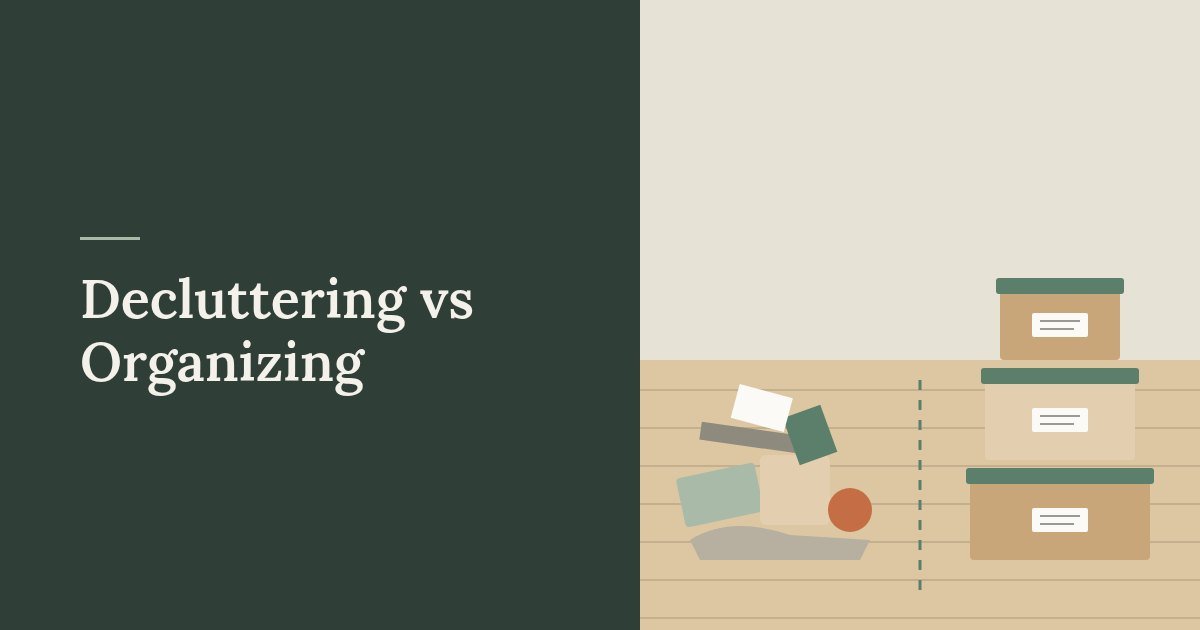
The difference in decluttering vs organizing is simple: decluttering reduces how much you own, organizing arranges what you have decided to keep. They are two different jobs, they use different tools, and they are not interchangeable. Most homes that feel disorderly have been organized repeatedly and decluttered never.
The practical test is this. If a closet is full of things you use, you have an organizing problem. If it is full of things you do not use, no shelf, bin, or label will fix it, because the volume is the problem.
Decluttering vs organizing: the actual difference
Decluttering is a decision process. You are answering one question per item: does this stay in the house. The output is a smaller number of things and usually some bags by the door.
Organizing is a design process. You are answering a different question: where does this live, and how does it get back there. The output is a layout, containers sized to the items, and a path for putting things away.
The mistake is treating organizing as the solution to volume. Containers do not reduce anything. A bin holds the same number of objects whether or not you needed them, and it adds one more object to the room.
Decluttering vs organizing, side by side
| Decluttering | Organizing | |
|---|---|---|
| The question you answer | Does this stay in the house? | Where does this live, and how does it get back? |
| What changes | How much you own | Where things sit and how easy they are to return |
| Tools | Bags, boxes, a clear floor to sort on | Containers, dividers, labels, hooks, shelves |
| How long a session runs | 30 to 90 minutes before decisions get sloppy | As long as you have energy, it is not a decision task |
| Done looks like | Fewer items, empty space on the shelf | Every item has one home, and returning it takes one step |
| Fails when | You sort without deciding, so piles just move | The volume still exceeds the space |
| Cost | Usually nothing | Whatever the containers cost |
| Order | First | Second |
The last row is the whole article. The order is not a preference, it is a dependency.
Why organizing first almost always fails
Three reasons, all mechanical.
You buy the wrong containers. Container size has to follow item count. If you measure and buy before you have decided what is staying, you are sizing storage for a quantity that is about to change. That is how people end up with a closet full of half-empty bins and a shelf that will not close.
You run out of easy space and start using hard space. Every room has prime space, meaning between knee and shoulder height, at the front, and secondary space, meaning high shelves, the back of deep cabinets, under beds. When volume is too high, daily items get pushed into hard space. Then putting away takes three steps instead of one, and things stop going back.
You organize the same stuff twice. If you have organized a space more than once in a year and it drifted both times, the system is not the weak link. The amount is. An arrangement that only holds when you are being careful is not an arrangement, it is maintenance you are doing by hand.
There is a related trap: sorting is not deciding. Grouping everything into categories feels like progress because the floor looks better by the end, but if nothing left the house, you have just rearranged the volume into neater piles.
When decluttering is the right move
Decluttering is the right job when any of these is true of a space:
- Things are stored on top of other things, or in front of other things.
- You own multiples of an item and could not say how many without counting.
- You cannot see the back of the shelf, the back of the closet, or the floor of the pantry.
- Items in the space have not been touched in a year, and nothing about the next year will change that.
- Putting one thing away requires moving two other things first.
- You have already organized this space and it drifted back.
Run it as a decision pass, not a tidying pass. Pick one container-sized area, a single drawer, one shelf, one closet rod section. Take everything out, put the keepers back, and move the rest out of the room in a bag the same day. Keep sessions short, because decision quality drops long before energy does.
When organizing is the right move
Organizing is the right job when the volume already fits the space and the problem is friction:
- Everything in the space is used, but you cannot find a specific item quickly.
- Items are used together but stored apart, like tape in one room and scissors in another.
- Things have a home, but the home is in hard space, so they do not get returned.
- Several people use the space and nobody could say where a given item belongs.
- The space is empty enough but still reads as busy, because small loose items are visible.
Organizing also comes back around after a declutter, and that is the point. Once volume is down, container choices get obvious because you are measuring real quantities.
How to tell which problem you actually have
Two checks, five minutes total.
- The empty-space check. Open the space and look for deliberately empty room: a gap on the rod, a few inches at the front of a shelf, a drawer that is not full. If there is none anywhere, you have a volume problem. Start with decluttering.
- The one-step check. Pick five items currently out of place in the room. For each one, count the physical steps to return it: open the cabinet, move the box, lift the lid, put it in. Anything over two steps will not hold during a busy week. If most items pass this and the room is still disorderly, you have an organizing problem.
Then make the call per space, not per house. A kitchen can be an organizing job in the same week that a garage is firmly a decluttering job.
Run them in order, in one space at a time
The sequence that works:
- Pick one space small enough to finish in a single session.
- Declutter it. Decide, remove, get the bags out of the house.
- Measure what is left. Count the items, measure the shelf depth and the rod length.
- Then organize. Buy or repurpose containers that match those numbers, and put daily items in prime space.
- Leave visible empty space on purpose, because a space packed to capacity has nowhere to put the next thing.
Finish one space before starting the next. A house with one finished closet and nine untouched ones is further along than a house with ten spaces half sorted.
Decluttering vs organizing is not a debate about philosophy, it is a question of which problem is in front of you, and you can usually answer it in five minutes with the two checks above. For the room order and the per-room checklists that follow this same sequence, see the Zen Living Room-by-Room System page.

0 Comments